
Digital Literacy for Older Adults: Staying Safe Online

Technology can make everyday life easier—but it can also bring new questions and challenges. How do you know if a message is really from your bank? What should you do if you receive a suspicious email or text? How can you protect your personal information online?
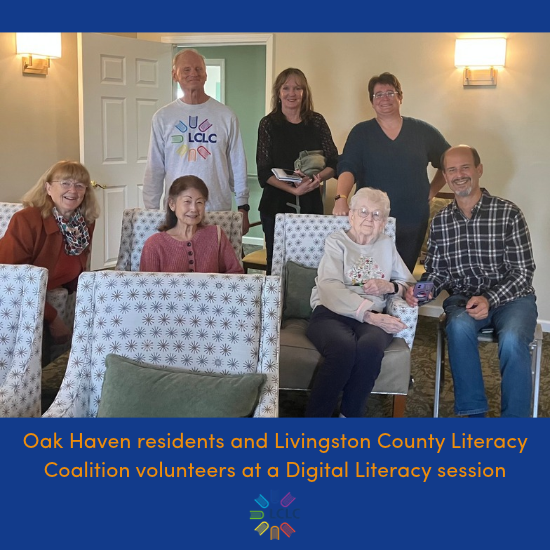
Those were some of the conversations happening today at Oak Haven Manor, where residents gathered for the second session in the Livingston County Literacy Coalition's Tech Talks Learning Sessions.
LCLC volunteer tutor Josie Doefer led today's session, with LCLC volunteer tutor and Board Member Dale Karolak joining residents and helping throughout the program.
This three-part digital literacy series began in February with Phone Basics. Today's session focused on Online Security, and the series will continue in April with a session about Social Media.

Talking About Internet Safety
Today's discussion focused on internet safety, including how to identify scams, protect personal information and navigate the online world more safely.
It didn't take long to discover just how relevant the topic was.
Many participants had encountered internet scams themselves and brought their own experiences to the conversation. That gave residents an opportunity not only to learn new information, but also to share what they had experienced and offer insight to their neighbors.
Josie said the topic was an especially good fit for the group because participants had firsthand experiences with internet scams and valuable insights to share with their peers.

Practical Help for Everyday Technology
Tech Talks are about more than presentations. They're also an opportunity for participants to ask questions and get help with the technology they use in everyday life.
Today, Josie and Dale were there to answer questions and provide hands-on support. The session even included helping a couple of residents set up Find Hub, which can help them locate their phones if they are lost.
It's a great example of what digital literacy can look like in practice.
Sometimes it's recognizing a suspicious message before clicking a link. Sometimes it's learning a new feature on your phone. And sometimes it's simply becoming comfortable enough with technology to ask questions and try something new.

Why Digital Literacy for Older Adults Matters
Digital literacy for older adults is increasingly important as technology becomes part of nearly every aspect of everyday life. When we hear the word literacy, we often think first about reading and writing. But navigating today's world requires many kinds of literacy.
Adults increasingly use technology to communicate, find information, complete forms, access services and manage everyday tasks. Knowing how to use those tools—and how to use them safely—is an important part of independence and lifelong learning.
That's why digital literacy is part of the Livingston County Literacy Coalition's work.
Our goal isn't to make everyone a technology expert. It's to create opportunities for adults to learn practical skills, ask questions without judgment and build confidence one step at a time.
Next Up: Social Media
There's one more Tech Talk ahead at Oak Haven Manor.
On April 13 at 2 p.m., we'll return for a session focused on Social Media.

Today's conversation was a wonderful reminder that learning doesn't have an age limit. Residents asked questions, shared experiences and learned from one another—and that's exactly what we hope these sessions make possible.
Because literacy isn't only about what you already know. It's also about having the tools, confidence and support to keep learning throughout your life.

Comments